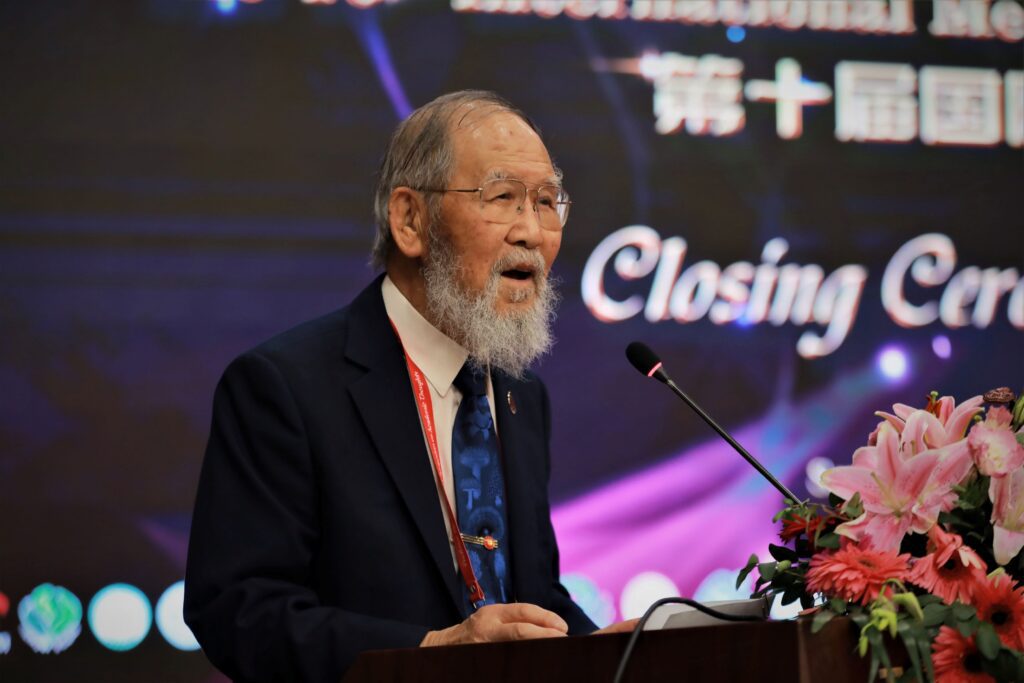
Professor Shu-Ting Chang, widely recognised as a giant of mushroom science, passed away on September 19th. Jianping Xu wrote the following In Memoriam on behalf of the ISMS executive committee.
It is with profound sadness that we note the passing of Professor Shu-Ting Chang, Emeritus Professor of The Chinese University of Hong Kong and a world-renowned mycologist, on the evening of September 19, 2026, in Australia, at the age of 96 (1930–2026). For more than six decades, Professor Chang worked tirelessly to promote mushroom science, helped elevating mushrooms to the forefront of global food security, human health, and environmental protection. He was a member of ISMS Executive from 1996-2004 and the inaugural life member of the society.
Born in 1930 in Yuanping, Shanxi, Professor Chang graduated from National Taiwan University in 1953 before pursuing advanced studies at the University of Wisconsin, where he earned his Master of Science (1958) and Doctor of Philosophy (1960) degrees. In 1960, he joined The Chinese University of Hong Kong (then its predecessor, Chung Chi College) as a lecturer in biology, rising through the ranks to serve as Chair of the Department of Biology (1983–1994), Dean of the Faculty of Science (1974–1977), and Chair Professor. After retiring in 1995, he was awarded the titles of Emeritus Professor and Emeritus Fellow. His service to CUHK spanned more than thirty-five years, during which he contributed deeply to the academic and administrative development of the Department of Biology and the Faculty of Science.
Professor Chang made outstanding contributions in transforming mushroom research from a traditional cultivation technique into an independent interdisciplinary field. Together with Professor Philip G. Miles, he conceptualized the distinction between “mushroom science” (concerned with fundamentals of mushroom production including mushroom biology) and “mushroom biotechnology” (concerned with mushroom products). In 1993, he convened the First International Conference on Mushroom Biology and Mushroom Products, which directly led to the founding of the World Society for Mushroom Biology and Mushroom Products (WSMBMP).
On the applied front, he contributed to reshaping the global edible mushroom industry. In 1969, he pioneered the cultivation of straw mushrooms using cotton textile waste, opening a new path for the effective utilization of agricultural waste. He developed protoplast monokaryotization technology to enable the maintenance of genetic materials within whole haploid nucleus for mushroom breeding. His contributions are especially felt inside China where since 1978, he set up numerous training workshops on edible fungi biology and cultivation, contributing to the rapid growth of the mushroom industry. In addition, on the cultural and historical perspectives, he helped authenticate the origin for artificial cultivation of shiitake mushrooms and provided crucial support for the designation of the “Forest–Mushroom Co-cultivation System” in Qingyuan, Zhejiang, China as a Globally Important Agricultural Heritage System by the UN Food and Agriculture Organization in 2022.
Professor Chang’s contributions to the international mushroom community were equally far-reaching. He published 23 books, authored 228 papers, and founded three academic journals over his lifetime. He served as Vice President of the International Society of Mushroom Science and was deeply involved in the society’s academic leadership. His footprints spanned more than 70 countries across five continents. He was a generous mentor who cultivated a large cohort of academic leaders for the global mushroom community, helped building core platforms for global academic exchange on edible and medicinal mushrooms.
His academic philosophy has had a lasting impact. He proposed the concept of the “Non-Green Revolution” in agriculture — emphasizing the fact that mushrooms can convert lignocellulosic waste in agriculture and forestry into high-quality nutrients while creating a zero-emission environment, offering a unique “mushroom solution” to global food shortages, environmental pollution, and health challenges.
Professor Chang’s contributions to mushroom science have been well recognized. He received numerous honors, including China’s National Friendship Award, Zhejiang Province’s West Lake Friendship Award, Shanghai’s Magnolia Honor Award, and the Officer of the Order of the British Empire (OBE).
In the picture: Prof. S.T. Chang delivering a speech at the closing ceremony of the 10th International Medicinal Mushroom Conference (IMMC10) at the Alphay Bio-Technology campus in Nantong, China, September 2019.